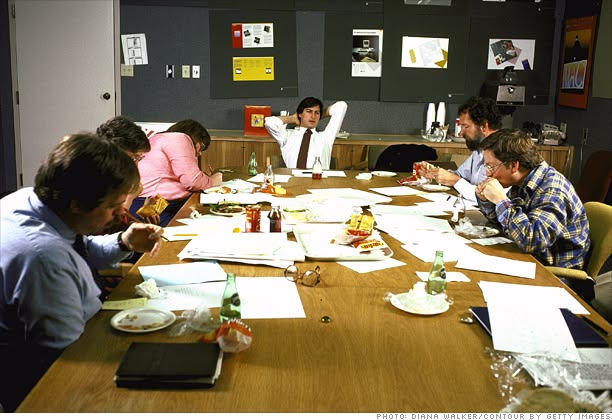
Jay Elliot and Steve Jobs · Apple · Early 1980s
About Jay Elliot
A flag flew over the building where the Macintosh got built. Jay Elliot was inside it — five to fifteen hours a day, nearly every day, for six years.
Jay Elliot and Steve Jobs · Apple · Early 1980s
Where it started
The oversized windows of the second-floor restaurant at the Carmel Inn gave everyone a perfect view of the swimming pool below. A group of young men and women were happily cavorting in the water. Stark naked. At eight in the morning.
Most of the diners had no idea who they were. Jay did. They were the Macintosh team.
Somewhere in those days Steve started using a line: pirates, not the Navy. Jay never asked him where it came from, and says now he suspects it originally belonged to the late Jay Chiat, co-founder of the ad agency that would do so much extraordinary work for Apple. But Steve took it up, and it stuck, and it became the way an entire team understood itself.
Then somebody sewed a flag, and ran it up over the building.
“Why join the navy if you can be a pirate?”
Steve JobsThe code
It was not a licence to be difficult. Every crew that ever raised a black flag wrote articles first — the rules everybody agreed to before the ship left harbour. This was the Macintosh version, and Jay spent six years enforcing it.
The other thing about the flag
Piracy without a product is just noise. The Macintosh team could get away with the flag, the skinny-dipping and the rest of it for exactly one reason: at the end of it there was a machine on a table that nobody else could have built.
Jay's job was never to be the pirate. It was to make sure the ship came back loaded.
He'd already done a version of it twice. At IBM he designed the ticket machines for BART, watched a thousand people fail to use them on a single Saturday, and spent nearly a year redesigning around what those people actually did — machines he writes became the prototype for the ATMs now standing in every bank in the country. IBM declined to put their name on them. Then Intel, as director of California operations, reporting to Andy Grove and Gordon Moore.
Then a stranger in a restaurant offered him two jobs at once, and the next six years happened.
If you want in the room
Six weeks of live product reviews with Jay, run the way Apple ran them. Or start with the four questions, free, and find out what you're actually dealing with.